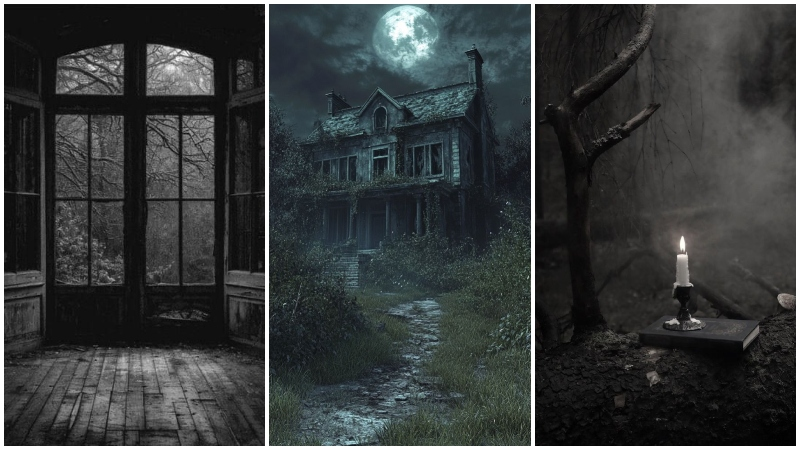
It was a dark and stormy night. The moonlight was faint, and the air carried a dampness that felt as if time itself had stopped. You stood before an ancient mansion, surrounded by tall, shadowy trees whose hanging branches seemed to be hiding countless secrets.
And from a distance, it looked as though long, dark tresses were swaying in the shadows.
That house, abandoned for centuries, seemed alive. The creaking of its wooden doors echoed faintly from afar, as if someone were calling us inside—or waiting for our arrival.
As the wind slipped through the cracks in the walls, it sounded like restless spirits whispering. The moment your foot touched the staircase, a piercing sound tore through the silence, and now your heart was racing.
In an instant, you felt the presence of someone standing right behind you, watching. Sweat gathered on your skin, and a chilling fear began to wrap itself around you. Cold moonlight filters in through the window, yet even within its glow lingers a sense of unease.
In one corner of the room, an old chair rocked gently back and forth—yet the air was still, wasn’t it? Yes, there was no breeze at all.
This is the true beauty of Southern Gothic: silence that turns into a scream, darkness that feels alive, and ruin that both terrifies and entices with its haunting charm. It is not merely a style—it is an invitation from another world, a tale whispering, “Come, read me.” And so the only question that remains is this: do you have the courage to uncover this mysterious, beautiful secret?
Where Did the Southern Gothic Aesthetic Come From?
Imagine this. It’s night, and you’re on a journey. Your car crawls down an old Southern highway, stirring clouds of dust into the heavy air. On both sides, towering silhouettes loom, their branches draped with Spanish moss—like the long, skeletal fingers of shadows reaching for the earth. The air is damp, burdened with stories too old to forget. This is the land where the Southern Gothic aesthetic took its very first breath.
Georgia – every old house holds walls that scream in silence. At dusk, sitting on the porch of a plantation home, you can feel eyes on you—watching, unblinking, piercing straight into your soul.
Louisiana – the streets of New Orleans dance with jazz, yet in the depths of night, the scent of voodoo and untold secrets lingers in the air. Here, the line between the living and the dead is always blurred.
Mississippi – along the riverbanks, the silence is so profound that every ripple of water carries centuries of sorrow in its voice.
Alabama – soil once soaked in blood and sweat still exhales a bitterness that time itself has never washed away.
South Carolina – when the coastal winds rise, they bring with them tales of lost love and spilled blood, hissing like unfinished ballads through the marsh grass.
Tennessee – by day, the mansions stand frozen in quiet dignity. But when night falls, echoes stir within—the faint tread of footsteps that never cease.
Eastern Texas – dense forests and desolate roads awaken the most primal fear of all: the terror of loneliness, alive and breathing.
The true beauty of Southern Gothic lies in this journey—it is not merely a map of geography, but of human emotion. Every bend in the road hides a story, and every shadow guards a secret. Some will frighten you. Some will draw you closer. But all will leave their mark.
The Secrets of an Old Diary
Southern Gothic is not just about collapsing walls, cracked furniture, or the strange beauty of shadows. At its core lies the human soul—the emotions we bury so deep we never dare to bring them to light. It is guilt that screams even beneath silence, secrets that grow heavier with passing years, and sorrow that lingers in the air of old mansions as though it never left.
Imagine… an old diary. Its pages faded, its ink nearly gone, the words themselves reduced to fragile shadows. Yet between those fragile lines hide truths never spoken aloud. Each sentence is a wound. Each word a scream—a scream that never found a voice, but one the darkness heard and kept.
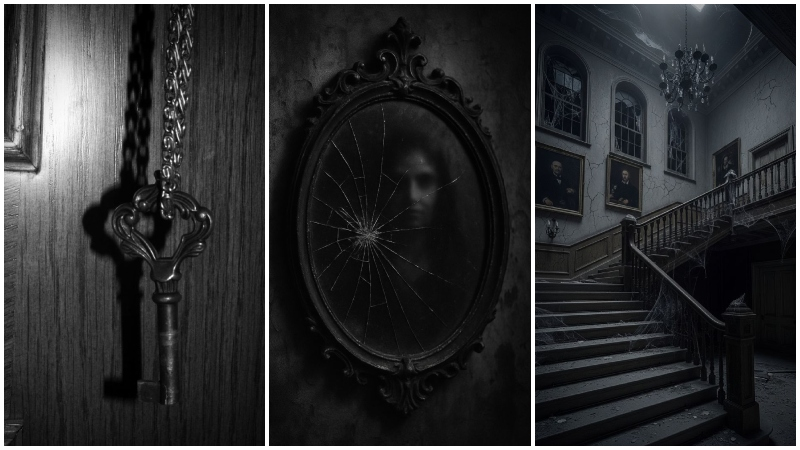
That is the essence of Southern Gothic: a mirror. A mirror that shows nothing in daylight, but in the dark forces us to confront our truest reflection. And when you dare to look into that mirror. Perhaps you will see more than just your own face.
The Union of Beauty and Decay
The true magic of Southern Gothic lies in its contrasts—where life and death, light and shadow, beauty and ruin coexist in a single frame. Imagine… a crimson flower, its petals spilling color in full bloom, yet placed in an ancient vase corroded with rust and cracks that prick at every gaze. The soft curves of the petals against the rough texture of the vase create a strange harmony—a spell of beauty intertwined with dread.
Inside the mansion, chandeliers still cast a faint glow, yet the wooden floorboards groan under each step. Walking beneath trees draped in Spanish moss, the breeze carries not only a chill but also the whisper of long-forgotten secrets. Every corner, every shadow, every window reminds you that Southern Gothic is not merely seen—it is felt.
This aesthetic teaches one enduring lesson: beauty is not always found in light. Sometimes, it reveals its deepest colors amidst decay, under the shadows, in the heart of darkness. And in that union—of beauty and ruin—lies its true secret and its hidden soul.
The Spiritual Dimension
The spiritual side of Southern Gothic always emerges between silence and shadows. The flicker of dim candles, the subtle creak of ancient crosses, shadowed churches—these elements evoke a constant struggle: hope versus despair, heaven versus hell. Each candle’s flame dances, yet its light feels as if it could be extinguished at any moment, reminding you that the spiritual path is never straight.
Imagine… the interior of an old church: soft light streams through the windows, falling across the worn pews, while the shadows along the ancient walls create a strange blend of fear and calm. It is a visual reminder that life is never purely black or white; within every human being exists a spectrum where faith and doubt, love and sorrow, light and darkness breathe together.
This spiritual facet of Southern Gothic always reminds us that every shadow holds a story, and behind every beam of light lies a secret—a mirror in which one can glimpse the true colors of their soul.
Southern Gothic Today
Most people still see it as just an “old style,” but contemporary artists are bringing it into a new light. Instagram photographers and TikTok creators are using Southern Gothic in moodboards and short films. Interior designers are blending it with minimalism—modern spaces accented with an antique mirror or a rusty chandelier.
Symbols That Tell a Story
- Rusty Keys → hidden secrets
- Broken Mirrors → a shattered past
- Spanish Moss Trees → the passage of time
These small details layer the aesthetic with meaning, making it richer and more evocative.
A Path to Healing
One of the least discussed aspects is that Southern Gothic can also be a tool for healing. Accepting the “imperfections” of life, transforming sorrow into beauty—this is the hidden charm of the aesthetic.
Conclusion
The Southern Gothic aesthetic is not just a “dark style”; it is a language. A language through which silence tells stories of human emotion, history, and spirituality. It carries sorrow, beauty, and a strangely calming, haunting presence that makes it timeless.
contect us for more information